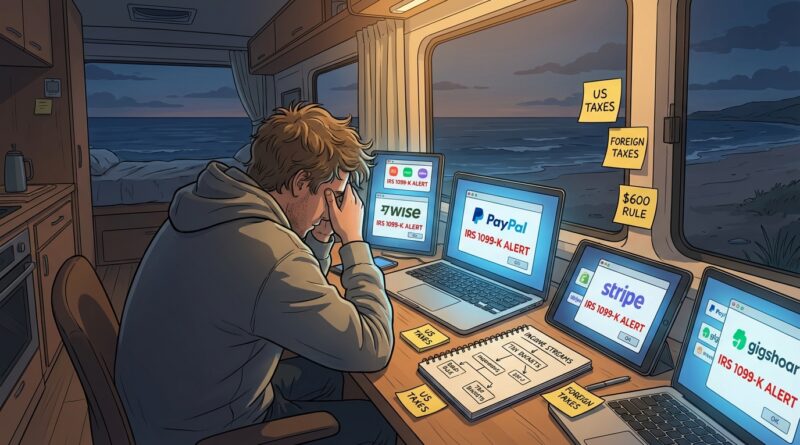
The $600 Trap: How New Payment App Tax Rules Could Blindside Digital Nomads In 2026
If you are a digital nomad getting paid through PayPal, Wise, Stripe, Upwork, Venmo, or similar apps, this is one of those boring tax changes that can turn into a very expensive headache. A lot of people still think the 1099-K $600 rule is just an Etsy seller problem. It is not. If you are an American freelancer living in Lisbon, Bali, Mexico City, or anywhere else, the IRS is about to get a much clearer view of your payment activity. That does not automatically mean you owe more tax. But it does mean mismatches, bad records, mixed personal and business payments, and forgotten transfers are much more likely to trigger letters, stress, and cleanup work. The smart move now is simple. Treat every payment platform like it will report you, keep cleaner books than you think you need, and set aside cash before tax season sneaks up on you.
⚡ In a Hurry? Key Takeaways
- The 1099-K reporting threshold is scheduled to drop to $600 in 2026, so many more freelancers and digital nomads will receive tax forms from payment apps.
- Start separating business and personal payments now, track every invoice, and reconcile platform payouts with your own records every month.
- A 1099-K does not always equal taxable profit, but bad documentation can make the IRS assume it does.
Why this matters more than most nomads realize
The biggest misunderstanding is this. People hear “$600 rule” and think it means a new tax. It is not a new tax. It is a reporting rule.
A 1099-K is the form payment platforms send to you and the IRS to report certain payment transactions. When the threshold drops to $600, many people who never got one before will suddenly start seeing them in their inbox or mailbox.
That includes location-independent freelancers, consultants, designers, developers, creators, coaches, and solo business owners who get paid through online platforms.
If that sounds like you, the risk is not just paying tax. You were already supposed to report your income. The real risk is that the IRS now has a paper trail from payment platforms, and your tax return needs to line up with it.
What the 1099-K $600 rule actually means
Under the lower threshold scheduled for 2026, payment platforms may issue a 1099-K once your reportable payments total more than $600 for the year.
That is a huge change from the old standard many people got used to, where reporting kicked in only at much higher transaction and dollar amounts.
In plain English, this means small and mid-sized freelancers will get swept in.
Who may send you a 1099-K
Depending on how you get paid, forms may come from:
- PayPal
- Stripe
- Square
- Venmo for business payments
- Cash App for business transactions
- Upwork or other marketplaces, depending on payment flow
- Other third-party settlement organizations
Wise can create confusion here. In some cases it acts more like a transfer service than a payment settlement platform. In others, the way funds move may still create reporting and recordkeeping issues. So do not assume “I use Wise, so this does not apply to me.” Check the account type, payment flow, and any tax documents the platform says it may issue.
What a 1099-K usually reports
Usually, gross payment volume. Not your net profit. Not your taxable income after expenses. Not necessarily even money that should all be taxed.
That is where digital nomads get tripped up.
Why digital nomads are especially exposed
If you live and work abroad, your finances often get messy fast, even if you are generally responsible.
You might invoice in dollars, get paid in euros, move money through Wise, pay expenses from a local bank, and pull some income from a platform dashboard that does not match what hit your account after fees and currency conversion.
That is normal. It is also exactly the kind of setup that can create tax confusion.
Common pain points for nomads
- Payments arriving in multiple currencies
- Platform fees reducing the amount that lands in your bank
- Client reimbursements mixed into business payments
- Transfers between your own accounts looking like income
- Personal payments from friends or roommates sitting in the same app as client revenue
- Foreign tax obligations on top of US filing requirements
- The Foreign Earned Income Exclusion making people think they can ignore tracking
That last one is a big one. Even if you use the Foreign Earned Income Exclusion or foreign tax credits, you still need accurate records. A tax break does not replace bookkeeping.
The most dangerous misunderstanding
Many freelancers think, “If I receive a 1099-K, that amount is what I owe tax on.”
Not quite.
The 1099-K amount is often gross business receipts processed by the platform. It may include:
- Amounts before fees
- Sales tax collected and passed through, in some setups
- Refunded transactions
- Reimbursements
- Duplicate reporting if your systems are sloppy
Your job is to report your actual business income correctly, then back it up with records if questions come up.
But here is the problem. If the IRS sees a 1099-K for $48,000 and your return only shows $31,000 with no clear explanation in your books, that can trigger attention fast.
What counts as taxable business revenue, and what does not
This is where clean records save you.
Usually taxable
- Client payments for freelance work
- Consulting fees
- Retainers
- Project deposits you keep
- Online service income
Not necessarily taxable in the same way, or not taxable at all
- Transfers between your own accounts
- Friend-to-friend reimbursements
- Refunds you issued to clients
- Amounts collected on someone else’s behalf
- Loan proceeds
The hard part is that payment platforms are not always perfect at separating these categories. So you need your own documentation to show what happened.
The cleanest setup for 2026 and beyond
If you want the low-stress version of this, set up your money flow so a stranger could understand it.
1. Use separate accounts for business and personal money
This is the biggest win. Have one primary business checking account and, if possible, one business payment app setup. Do not let your client payments mix with dinner reimbursements from friends.
If a platform allows both personal and business activity, use the business profile for business. It is not exciting advice, but it prevents a mountain of cleanup later.
2. Match every payment to an invoice
Every payment should point back to something. An invoice number. A client name. A contract. A date. A note in your bookkeeping system.
If you cannot answer “what was this payment for?” in under 30 seconds, future-you will hate current-you.
3. Reconcile monthly, not yearly
Once a month, compare:
- Your invoices
- Platform transaction reports
- Your bank deposits
- Your bookkeeping records
This catches duplicate payments, missing deposits, refunds, and fee differences while they are still fresh.
4. Track gross income and fees separately
If Stripe processed $5,000 and deposited $4,825 after fees, your books should usually show:
- $5,000 gross income
- $175 merchant or platform fees expense
Do not just record what landed in the bank and call it done. That is one of the easiest ways to create mismatches with a 1099-K later.
5. Keep screenshots and exports
Platforms change dashboards. Reports disappear. Account access can get weird when you travel.
Download monthly CSV files or PDFs. Save annual summaries. Keep copies in cloud storage you control.
How this can create surprise tax bills
The reporting rule itself does not create tax. But it can create surprise tax bills in a few very real ways.
You underreported because your records were incomplete
Maybe you forgot platform income that never hit your main checking account directly. The 1099-K reminds the IRS even if you forgot.
You did not save enough for taxes
A lot of nomads run lean. If payments increase and everything is moving through apps, it is easy to spend what feels available. Then tax season arrives and the cash is gone.
You assumed exclusions meant no filing stress
The Foreign Earned Income Exclusion can reduce taxable income for some people, but it does not excuse poor records. And self-employment tax rules can still bite depending on your situation.
You get a notice and have to prove the form overstates income
This is where sloppy records become expensive, not always because of tax owed, but because of time, accountant fees, and stress.
A simple cash-reserve rule that works
If your income is uneven, do not try to be too clever. Start with a dedicated tax savings account and move a percentage of every client payment into it as soon as you get paid.
For many freelancers, 25 to 30 percent is a reasonable starting point, though your actual number depends on income level, deductions, state ties, foreign tax credits, and whether self-employment tax applies.
If you are not sure, ask a cross-border tax professional. The point is not perfection. The point is to avoid using tax money as rent money.
What to do if you get a 1099-K that looks wrong
Do not panic. Also, do not ignore it.
Step 1: Compare it to your own records
Check gross receipts, date ranges, fees, refunds, reimbursements, and any payments that were personal or transfers between your own accounts.
Step 2: Contact the platform if the form appears incorrect
Ask whether they can issue a corrected form. Keep copies of all messages.
Step 3: Document your adjustments
If your books show why the reported total is higher than taxable business revenue, keep a clean summary and supporting files.
Step 4: File accurately, not emotionally
Do not force your return to match a wrong form if your records support a different correct number. But make sure the explanation is solid.
The best payment-routing playbook for nomads
If you want a practical setup, here is a good starting point.
- One business bank account in your home tax system
- One bookkeeping tool, even a simple one, used consistently
- One invoicing system with clear numbering
- Business-only payment profiles where possible
- Monthly exports from every platform
- A tax reserve account that you do not touch
If you use several platforms because clients prefer different methods, that is fine. Just funnel the recordkeeping into one clean system.
What not to do
- Do not mix client payments with personal transfers in the same payment app if you can help it
- Do not record only net deposits after fees
- Do not assume living abroad means the IRS cannot see platform activity
- Do not wait until January to figure out what happened last July
- Do not treat every 1099-K amount as automatically correct
When it is worth paying a pro
If you have any two of these at the same time, get help:
- US tax filing
- Foreign residency or local tax obligations
- Self-employment income
- Multiple currencies
- Several payment platforms
- FEIE or foreign tax credit questions
You do not need a fancy wealth manager. You need a tax pro who understands freelancers and cross-border issues. A few hundred dollars for good advice can save you far more in mistakes.
At a Glance: Comparison
| Feature/Aspect | Details | Verdict |
|---|---|---|
| Reporting threshold | The planned $600 trigger means far more freelancers and solo businesses may receive a 1099-K. | Assume your payment activity may be reported. |
| What the form shows | Usually gross payments processed by the platform, not your final profit after fees and expenses. | Useful, but not the whole tax story. |
| Best defense | Separate accounts, clean invoicing, monthly reconciliations, and a tax cash reserve. | This is the playbook that keeps small issues from becoming big ones. |
Conclusion
The 1099-K $600 rule digital nomad problem is not really about one form. It is about visibility. The IRS is phasing in much lower reporting thresholds for payment platforms, with a $600 trigger scheduled for 2026 that will dramatically increase the number of 1099-K forms freelancers and solo-business owners receive. For digital nomads who already juggle foreign tax rules, multiple currencies, and irregular income, that shift can easily mean unexpected tax bills, messy audits, and confusion about what actually counts as taxable business revenue. The good news is that this is fixable now. Route payments more cleanly. Document income better than you think you need to. Keep reserves for taxes before the money feels spendable. Do that, and you protect your runway, reduce nasty surprises, and keep moving toward financial independence instead of burning months untangling a compliance mess.