The New ‘Coast Nomad’ Strategy: How Part‑Time Travel Is Quietly Beating Full‑Time FIRE For Remote Workers
You are not lazy if full-time digital nomad life sounds exhausting. And you are not failing at FIRE if the math keeps moving further away every time rent, flights, and groceries jump again. A lot of remote workers are stuck in that exact middle. They want more freedom now, not at 65. But they also do not want to torch their savings, live in airports, or bet their whole future on a backpack and a shaky Wi-Fi signal.
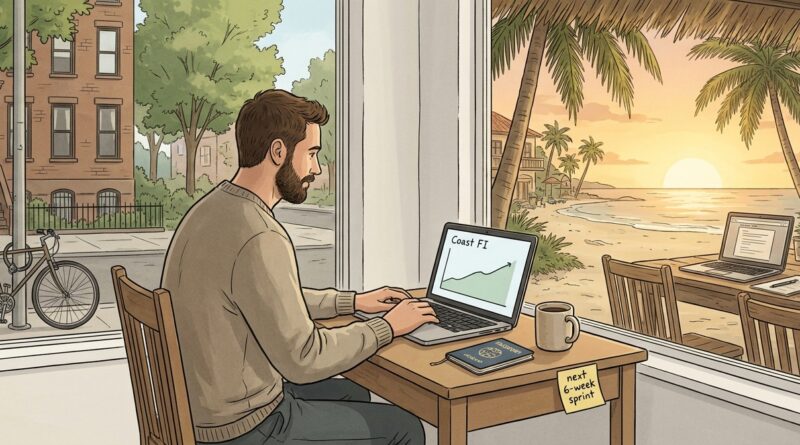
That is why a quieter strategy is catching on. Think of it as the coast fi digital nomad strategy. You build a solid financial base first, then travel part of the year instead of all of it. You keep enough stability to protect your career and savings rate, but you still get the emotional payoff of new places, slower living, and room to breathe. It is less flashy than quitting forever. It is also a lot more doable for normal people.
⚡ In a Hurry? Key Takeaways
- The coast fi digital nomad strategy means building enough invested assets that retirement can grow on its own, then using part-time travel instead of full-time nomadism.
- Start with a home base, a travel season, and a fixed annual budget so you can test freedom without blowing up your savings plan.
- This hybrid approach is often safer than full-time travel because it lowers burnout, visa stress, and income risk while still giving you real lifestyle gains now.
Why full-time FIRE and full-time nomad life both feel broken right now
For years, the dream came in two versions.
Version one was FIRE. Save aggressively for a decade or two, invest hard, then quit for good. Nice in theory. Rough in practice when markets swing, housing costs keep rising, and your income does not climb as fast as your expenses.
Version two was full-time nomad life. Sell everything. Book the one-way flight. Work from beaches, cafés, and short-term rentals forever. Also nice in theory. Less nice when you are juggling time zones, carrying your whole life in one bag, and paying tourist prices for basics.
That leaves a lot of people feeling weirdly stranded. Too restless to stay put. Too cautious to go all in.
The good news is you do not have to pick one extreme.
What the coast fi digital nomad strategy actually is
Coast FI means you have invested enough money that, if you stopped contributing today and just let it grow, it could still fund a traditional retirement later. You are not financially independent yet. But you no longer have to save at maximum intensity forever.
Now mix that with part-time location independence.
Instead of trying to travel every month of the year, you create a setup like this:
- A stable home base for 6 to 9 months
- One or two slower travel stretches each year
- Remote work that stays manageable
- A savings rate that is still healthy, even if it is no longer extreme
That is the heart of it. You are coasting financially, but not drifting. You are traveling intentionally, not escaping your life.
Why this hybrid path is quietly beating the old dream
1. It cuts burnout fast
Full-time travel sounds romantic until every week turns into logistics. New SIM cards. New beds. New kitchens. New neighborhoods. New tax questions. New visa deadlines.
Part-time travel keeps the fun parts and removes a lot of the friction. You can stay longer in each place and return home before your brain feels fried.
2. It protects your income
A lot of remote workers make their best money when they are boring. Reliable schedule. Good internet. Good sleep. Familiar setup.
The coast fi digital nomad strategy gives you room to travel without wrecking your work performance. That matters more than people admit. A 10 percent drop in income can do more damage to your long-term plan than a cheaper apartment abroad can fix.
3. It lowers lifestyle inflation
Funny enough, full-time travel can become expensive. Constant flights, short-term rentals, coworking passes, and last-minute bookings add up. So does the tendency to treat every place like a mini vacation.
With a home base, you can keep core costs steadier and use travel windows when deals and seasons make sense. If rising costs are eating at your plan, it is worth reading Inflation-Proof Your Nomad Life: How To Lock In Today’s Prices So You Can Reach FI Even If Costs Keep Climbing. It lays out a very practical way to stop your “cheap” nomad budget from slowly turning into an expensive one.
4. It handles real life better
Family needs happen. Relationships happen. Health stuff happens. Work changes happen.
A hybrid setup bends better. You still have a mailing address, a doctor, a routine, and a place to land. That is not boring. That is useful.
How to know if this strategy fits you
This path usually makes sense if most of these sound like you:
- You want freedom soon, not just someday
- You like travel, but not constant motion
- You want to keep building your career or business
- You feel behind on FIRE and want a plan that feels achievable
- You care about comfort, health, and stability more than internet bragging rights
If your dream is truly nonstop global travel for years, that is fine. But many people do not actually want that. They want relief, novelty, better weather, and a bigger sense of choice. That is different.
A practical 5-step playbook
Step 1: Define your Coast FI number
You need a target. A simple version works like this: estimate what you want for retirement spending, then work backward to the amount your current investments would need to grow into by retirement age.
Example. If you want $40,000 a year in retirement, you might aim for roughly $1 million invested eventually, using a 4 percent rule as a rough guide. If you are 35 and expect growth over 25 to 30 years, your Coast FI number today could be much lower than $1 million.
You do not need perfect math on day one. You need a reasonable checkpoint.
Step 2: Pick a home base before you pick destinations
This is where many people get it backward. Your home base is the engine that makes the whole plan work.
Look for:
- Predictable rent or housing costs
- Good healthcare access
- Solid airport connections
- A place you can happily return to
- Low mental overhead
Your base does not need to be glamorous. It needs to be efficient.
Step 3: Create a travel season, not a travel identity
This is the mindset shift. Do not ask, “How do I become a full-time nomad?” Ask, “Which 8 to 12 weeks each year would make me feel most alive?”
Maybe that means:
- January and February in Mexico
- One month in Portugal each spring
- A six-week summer stay in Southeast Asia
Longer stays are usually cheaper, calmer, and better for work than bouncing every 10 days.
Step 4: Use a two-bucket budget
Keep your money simple. One bucket is fixed life. The other is freedom.
Fixed life bucket: rent, insurance, subscriptions, debt payments, groceries at home, retirement contributions.
Freedom bucket: flights, short-term housing, local transit, travel insurance, extra dining out, coworking, visa fees.
This shows you whether travel is truly affordable or just being hidden by blurry spending.
Step 5: Test it for one year before redesigning your whole life
You do not need a dramatic exit. Try one hybrid year.
Keep your job. Keep your base. Travel in defined windows. Track how you feel, what you spend, and whether your work holds up.
After one year, you will know more than three years of daydreaming could tell you.
Common mistakes that sink the plan
Treating travel like a reward for burnout
If you are already fried, travel can feel amazing for two weeks, then become one more thing to manage. Build systems first. Then book flights.
Choosing expensive “nomad hubs” by default
If everyone else on social media is in the same trendy spot, prices are probably inflated too. You do not have to go where the content is.
Ignoring tax, insurance, and visa limits
This is not the sexy part, but it matters. Part-time travel is easier partly because you are less likely to get tangled in residency questions and long-stay paperwork. Still, check the rules every time. They change.
Dropping savings too far, too soon
Coast FI is not an excuse to stop paying attention. If your investments are nowhere near a true Coast FI level, be honest. You can still do a lighter version by taking one or two low-cost remote stints each year while you keep building.
What this can look like in real life
Picture a 34-year-old remote product manager with $180,000 invested, a decent salary, and rising rent in a high-cost city. Full FIRE still feels far away. Full-time nomad life sounds fun for a month, then awful.
So they move to a lower-cost home base. They keep working. They save enough to keep momentum, but not at a crushing rate. They spend February in Valencia, June in Mexico City, and three weeks in Chiang Mai in the fall. The rest of the year they are stable, productive, and sleeping in their own bed.
That person is not “retired.” They are also not waiting 20 years to feel free.
That is the point.
At a Glance: Comparison
| Feature/Aspect | Details | Verdict |
|---|---|---|
| Full-time nomad life | Maximum flexibility, but higher logistics, burnout risk, and often less predictable costs | Best for a small minority with high tolerance for instability |
| Traditional FIRE grind | Strong long-term focus, but can delay lifestyle freedom for many years and feel emotionally draining | Works if you can sustain the pace and timeline |
| Coast FI + part-time travel | Mixes a stable financial base with seasonal travel, lower risk, and more realistic day-to-day living | Best balance for many remote workers right now |
Conclusion
You do not have to choose between grinding endlessly and disappearing into full-time nomad chaos. More people in the FI and remote work world are quietly moving toward this middle path because it fits real life better. A modest Coast FI base plus intentional part-time travel can give you a surprising amount of freedom without wrecking your savings, your career, or your nervous system. In a year of shaky markets, higher living costs, and tighter visa rules, that matters. If you have been feeling behind, this is your reminder that freedom does not have to arrive all at once. It can start in seasons. And for a lot of people, that is not settling. It is finally building a life they can actually keep.