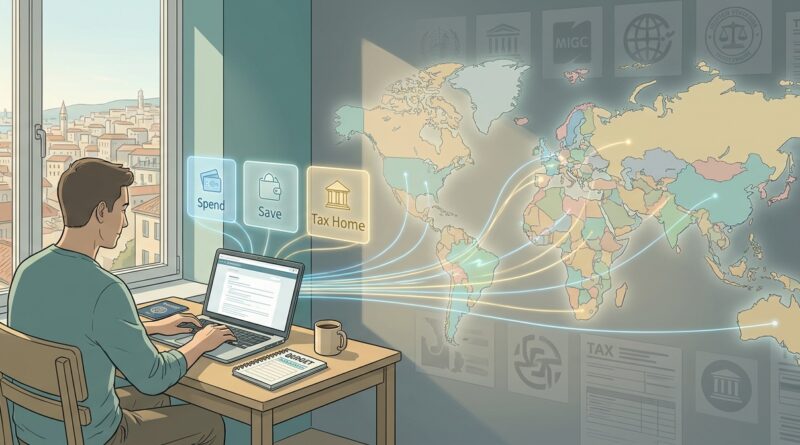
The New ‘Borderless Bank Account’: How Multi‑Country Tax Swaps Are Quietly Changing the Game for Digital Nomads in 2026
If you are a digital nomad with money coming in through PayPal, Wise, Revolut, Stripe, or a local bank app, you have probably had that nagging feeling that your setup is getting too messy to explain. That feeling is not paranoia. Tax offices are getting better at sharing account data, matching payment flows, and asking a simple but stressful question: where was this money really earned, and where should it have been taxed? For people chasing financial independence, this matters more than ever. One surprise audit or retroactive tax bill can wipe out years of careful saving. The good news is that “safe” does not mean complicated. In most cases, it means building your banking setup around one clear tax home, cleaner records, and fewer random money hops between apps. The old under-the-radar approach is getting riskier. A boring, well-documented setup is now the smarter move.
⚡ In a Hurry? Key Takeaways
- Your safest digital nomad taxes 2026 bank accounts setup is usually one main tax residence, one primary business account, and clear records showing where income was earned and where it landed.
- Use payment apps like Wise, PayPal, and Revolut as tools, not as your “tax plan.” Download statements, label transfers, and reduce needless account-to-account shuffling.
- Messy flows can trigger tax questions years later. Clean documentation protects your savings, residency plans, and long-term FI strategy.
The quiet change most nomads are missing
A lot of people still think the risk is just “getting a tax form.” It is bigger than that.
The real shift in 2026 is that more tax agencies are connecting the dots between payment platforms, cross-border transfers, local banking activity, and residency claims. If you spend half the year saying you earn abroad, but your money is constantly landing in local accounts, getting paid by local clients, or moving through five apps with no paper trail, that story gets harder to defend.
This is especially true in places that have openly flagged remote workers, creators, freelancers, and online sellers for extra attention. Spain, Canada, and several EU countries have become much more direct about digital income and account tracing. The days of “nobody will notice” are fading fast.
What a “borderless bank account” really means now
For years, the dream setup sounded simple. Open a few fintech accounts. Get paid in one currency. Convert in another. Spend wherever you live this month. Keep things flexible.
That flexibility is still useful. But tax-wise, a borderless setup now needs a center of gravity.
Think of your money system like luggage at an airport. If every bag has a tag and all roads point back to the same traveler, things move smoothly. If your bags are scattered across four terminals with different names on the labels, someone is going to pull you aside.
A safe setup does not mean you need only one account. It means each account has a job, and all of them support one clear tax story.
What tax offices are looking for
They are not just looking at raw balances. They are looking for patterns.
1. Where income first arrives
If client payments hit a personal wallet, then move to a fintech app, then to a local account, then back out again, that can look sloppy. It may still be legal, but it raises questions.
2. Whether your spending matches your tax claims
If you claim to be taxed elsewhere but most of your life happens in one country, including rent, groceries, utilities, and ATM withdrawals, that country may take interest.
3. Whether you can prove foreign-source income
More authorities now want more than “my client is international.” They may want contracts, invoices, platform statements, work logs, and proof of where the service was performed.
4. Whether your apps are generating reports
If you have not read up on payment reporting thresholds and app-based tax visibility, start with The $600 Trap: How New Payment App Tax Rules Could Blindside Digital Nomads In 2026. It is one of those boring topics that gets expensive fast when ignored.
The safest setup for most digital nomads in 2026
There is no universal one-size-fits-all answer, especially for US citizens, EU movers, or people using company structures. But for many solo freelancers and remote workers, the safest setup looks surprisingly plain.
Pick one real tax base
This is the anchor. Your tax residence, or your company’s tax home if relevant, should drive the rest of your banking setup.
Ask yourself:
- Where am I actually filing taxes?
- Where can I support my residency claim with documents?
- Where would I want a tax officer to start if they reviewed my finances?
If you cannot answer those clearly, your first problem is not banking. It is tax residence.
Use one primary account for income collection
Your best move is usually one main business or income account tied to your tax base. That can be a traditional bank account or, in some cases, a reputable fintech account if it is properly documented and suitable for your business type.
The key point is this. Make one account the “front door” for income.
That account should receive:
- Client payments
- Marketplace payouts
- Platform income
- Employer salary, if you are a remote employee
Use secondary accounts for specific jobs only
Wise for currency conversion. Revolut for travel spending. A local bank for rent and bills in your current country. That is fine.
What you want to avoid is using all of them for everything.
A cleaner map looks like this:
- Main income account
- One transfer route to spending accounts
- One savings or investment route
- Minimal circular transfers
Separate business and personal money
This is basic advice, but many nomads still blur the line. If you are self-employed, mixing business income with brunch, flights, and random cash withdrawals makes tax proof much harder later.
Even if your country does not strictly require a separate business account, it often makes your life easier.
The money flows that create problems
Here are the setups that tend to age badly.
Getting paid into whichever app was convenient that week
This feels flexible in the moment. A year later, it becomes a detective project.
Moving money through multiple countries with no notes
If you transfer from Wise to Revolut to a local bank to another local bank, put labels on transfers and keep statements. Otherwise, even your own money can start to look mysterious on paper.
Using personal payment apps like they are accounting systems
They are not. They are payment rails. Useful, fast, convenient. But not a substitute for books, records, invoices, and tax logic.
Claiming foreign income with local-looking facts
If you tell one country your income is foreign but all signs point to local work, local clients, and local economic life, expect questions.
How to document your setup so it survives scrutiny
This is the part people skip. It is also the part that saves them.
Keep a simple account map
Make one page for yourself with:
- Account name
- Country
- Purpose
- Who owns it
- What money is allowed to flow through it
If you cannot explain an account’s purpose in one sentence, it may not need to exist.
Download statements every month
Do not trust apps to keep perfect access forever. Save PDFs or exports for every platform. Store them by year and month.
Match invoices to deposits
Each payment should connect to an invoice, contract, or platform payout statement. Make this boring and consistent.
Track where you were working
This matters more now. Calendar logs, flight records, accommodation receipts, and immigration stamps can all help support where services were performed.
Write short transfer notes
“Owner draw.” “Tax savings transfer.” “Rent funding.” “USD to EUR business conversion.” Tiny notes today can save hours later.
What to do if your current setup is already messy
Do not panic. You do not need to fix five years of history in one weekend.
Start with a cleanup date
Pick a date, ideally the start of a month or quarter. From that date forward, use the new cleaner system.
Close duplicate or unused accounts
If an app or account no longer serves a clear purpose, shut it down after downloading records.
Create a written explanation for old weird transfers
You do not need a novel. Just a plain-language note for anything large or unusual.
Talk to a cross-border tax professional before moving countries again
This is especially important if you are chasing tax-friendly residency. One move made on forum gossip can create years of cleanup.
For FI-minded nomads, this is really a compounding problem
People in the financial independence crowd often focus on expense ratios, geoarbitrage, and investment returns. Fair enough. Those matter.
But a tax mess is like a hidden negative return. It can hit late, hit hard, and come with penalties, stress, and frozen plans.
The point of a cleaner banking structure is not just compliance. It is protecting compounding.
When your setup is clear, you can compare countries based on real after-tax numbers, not Reddit folklore. You can invest with more confidence. You can apply for residency or visas without wondering what your bank trail says about you.
Practical checklist for a better digital nomad taxes 2026 bank accounts setup
- Choose one clear tax residence or tax home.
- Use one primary account as the main income landing spot.
- Keep business and personal flows separate.
- Use Wise, Revolut, PayPal, and similar apps for specific tasks, not all tasks.
- Reduce random transfers between platforms.
- Download monthly statements from every account and app.
- Match deposits to invoices, contracts, or payout statements.
- Track where you physically worked.
- Keep proof for major transfers and currency conversions.
- Review your setup before changing residency, opening a company, or adding a new country to the mix.
At a Glance: Comparison
| Feature/Aspect | Details | Verdict |
|---|---|---|
| Main income account | One primary account tied to your tax base receives most client or salary payments. | Best for clarity and easier tax proof. |
| Multiple fintech apps | Wise, Revolut, PayPal, and similar tools can help with travel and currency conversion, but too many overlapping uses create a messy trail. | Fine as support tools, risky as a core system. |
| Documentation and proof | Statements, invoices, contracts, location records, and transfer notes help show where income was earned and why money moved. | Non-negotiable if you want long-term safety. |
Conclusion
The big change here is not that governments suddenly care about digital nomads. It is that they now have better tools, clearer rules, and more interest in checking the details. Over the last year, places from Spain to Canada have openly flagged digital payments, neobanks, influencers, and remote workers as enforcement priorities. They are also asking for more proof that income was earned abroad rather than locally. That makes the old under-the-radar mindset a real risk for anyone building toward financial independence. A messy setup can lead to surprise tax bills years later, wipe out savings, and even hurt residency plans. The good news is that the fix is usually not exotic. Build around one tax base, simplify your accounts, and keep records that make sense to someone other than you. Do that, and you give your money a much better chance to keep compounding quietly, which is exactly what you want.