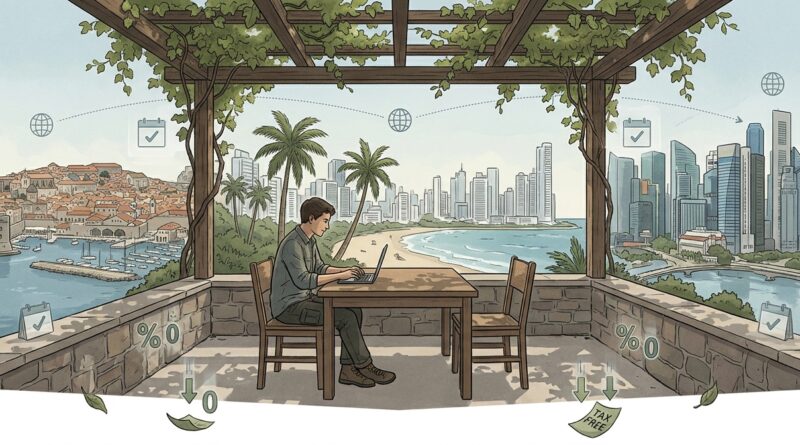
The New ‘Zero‑Tax Remote Worker’: How To Legally Pay Almost Nothing In Income Tax While You Travel
You are not crazy for feeling stuck here. One minute you are doing honest remote work from a high-cost home country, the next you are watching somebody post laptop-on-the-beach photos from Dubai or Georgia while casually hinting they pay almost no income tax. Then you try to figure out how they did it and run straight into a swamp of tax residency tests, visa rules, treaty jargon, and half-true advice on Reddit. It gets confusing fast.
The good news is this is not just a rich-person game anymore. A real zero tax remote worker digital nomad strategy usually comes down to three moving parts. Where you are tax resident, where you are allowed to live, and how your home country taxes worldwide income. Get those three right, and some remote workers can legally cut income tax to very low levels, or in a few cases near zero. Get them wrong, and the beach can get very expensive.
⚡ In a Hurry? Key Takeaways
- The basic play is simple. Stop being tax resident in a high-tax country, move to a country with low or zero tax for remote workers, and follow day-count and visa rules carefully.
- Start with a spreadsheet, not a dream board. Track income, days in each country, visa costs, health insurance, and whether your passport country still taxes you after you leave.
- This only works if it is legal on both the tax side and the immigration side. Bad residency planning can trigger back taxes, penalties, or an invalid visa.
First, what people actually mean by “zero-tax remote worker”
It rarely means magic. It usually means one of four things.
1. They live in a country with no personal income tax
Think places like the UAE. If your visa and tax residency are set up correctly, local income tax can be zero.
2. They use a special expat or digital nomad tax regime
Some countries tax foreign-source income lightly, not at all for a period, or only after you become a normal resident.
3. They broke tax residency at home and kept income under exclusions or treaty rules
This matters a lot for Americans using the Foreign Earned Income Exclusion, and for some Europeans who can fully leave their home tax net.
4. They are not as “zero-tax” as they sound
Many still pay social taxes, corporate taxes, self-employment tax, VAT, or payroll charges. Instagram captions tend to leave that part out.
The three-part framework that matters more than the country list
If you remember nothing else, remember this. A workable zero tax remote worker digital nomad strategy has three layers.
Layer 1. Tax residency
This is the big one. Most countries decide tax residency using some mix of:
- How many days you spend there, often 183 days or more
- Where your permanent home is
- Where your family lives
- Where your economic ties are strongest
If your old country still sees you as resident, your low-tax move may do very little.
Layer 2. Visa and legal stay
You need permission to be there. Tourist visas are often shaky for long-term remote work. Digital nomad visas, residence permits, and self-employed permits are the cleaner route.
Layer 3. Source of income and home-country rules
Some countries tax citizens no matter where they live. The United States is the famous example. Most others focus on residency, not citizenship. That one difference changes the whole plan.
Why Americans and Europeans need different playbooks
For US citizens
The US taxes citizens on worldwide income even when they live abroad. That means “move abroad and pay zero” is harder than it sounds.
The common tools are:
- Foreign Earned Income Exclusion. If you qualify, you can exclude a chunk of earned income from US federal income tax. The amount adjusts over time and is substantial, but not unlimited.
- Foreign Housing Exclusion or Deduction. This can help in high-rent cities.
- Foreign Tax Credit. Useful if you do pay tax abroad.
Important catch. The FEIE helps with federal income tax, but it does not automatically erase self-employment tax. Many freelancers miss that and get a nasty surprise.
For EU and most non-US citizens
The goal is often cleaner. Break tax residency at home, avoid creating a new high-tax residency somewhere else, and move to a country with low or zero tax. If your home country no longer taxes you as a resident, the savings can be dramatic.
But “breaking residency” is not just buying a plane ticket. Some countries look at housing, spouse, bank activity, local registration, and whether you really left.
The cleanest strategy types, from simplest to trickiest
Strategy A. Move to a true zero-income-tax country and become resident there
This is the most straightforward on paper. Countries often discussed include the UAE and a few territorial-tax or no-tax jurisdictions.
Who it suits: High earners, business owners, contractors with location flexibility, and people who want one stable base.
What can go wrong: You fail to break residency at home. Or your company payroll setup does not fit local rules.
Strategy B. Use a digital nomad visa with favorable tax treatment
Some countries invite remote workers in but either do not tax foreign-source income for a period, or offer a reduced setup compared with normal residents.
Who it suits: Employees and freelancers who want legal stay, banking, and a calmer setup than border-hopping.
What can go wrong: The visa is easy, but the tax side is not as generous as the headlines suggested.
Strategy C. The “non-resident almost everywhere” approach
This is the dream many people talk about. Spend limited days in many countries, avoid tax residency, and keep taxes tiny.
Who it suits: Very organized travelers with flexible lives and a high tolerance for admin.
What can go wrong: Almost everything. One bad day count, one tie-breaker issue, or one home-country challenge can blow it up. This is usually the least beginner-friendly option.
A numbers-first example for a US remote worker
Let’s keep it simple. Say you are a US freelance designer earning $110,000 a year.
- You move abroad full-time.
- You qualify for the Physical Presence Test for the FEIE.
- You base yourself in a low-tax country that does not charge local income tax on your setup.
Result. You may reduce or eliminate a large share of your federal income tax on that earned income.
But if you are self-employed, you may still owe US self-employment tax unless a totalization agreement or business structure changes the result. That means “zero income tax” does not always mean “zero tax bill.”
Now compare that with a US salaried employee whose employer can legally employ them abroad. Their payroll, state tax ties, and FEIE eligibility all need checking. Some states are stubborn about residency. California comes up a lot for a reason.
A numbers-first example for an EU remote worker
Say you are a German or French contractor earning €80,000 and can fully leave your home-country tax residency.
- You give up your local home base correctly.
- You stop triggering residency there.
- You move to a jurisdiction with low or zero personal tax on your income.
In some cases, the difference can be huge. You might go from a combined burden that feels crushing to something far lower, especially if local social charges also drop. But the paperwork matters. Some European countries do not just wave goodbye because you bought a one-way ticket.
Countries remote workers keep looking at, and why
UAE
The headline attraction is obvious. No personal income tax. Strong infrastructure. Real residency options.
Best for: Higher earners who can handle setup costs and want a stable base.
Watch for: Cost of living, visa fees, health insurance, and banking details.
Georgia
Popular because of simple living, relatively low costs, and business-friendly options. Tax treatment depends on structure and residency details, so do not assume “cheap country” equals “zero tax.”
Paraguay
Often mentioned for territorial tax ideas and low costs. Good on paper for some people, but not a plug-and-play answer. Residency and practical life setup matter.
Panama and Costa Rica
Territorial systems get attention because foreign-source income may be treated favorably. But definitions matter. So does how your work is sourced and invoiced.
Portugal, Spain, Greece, Italy
These are not zero-tax plays in the pure sense, but they sometimes offer expat-friendly or digital nomad pathways that can still beat staying home. If your goal is lower tax plus good lifestyle, not absolute minimum tax, they can be worth a look.
The five mistakes that trip people up
1. Confusing visa residency with tax residency
They overlap, but they are not the same thing. A country can let you live there without making you tax resident right away. Or the opposite can happen faster than you expected.
2. Forgetting the exit side
Your old country matters just as much as the new one. If you do not cleanly leave, your “tax-free” move can become double the stress.
3. Ignoring state or local taxes
This hits Americans hard. Federal planning is only part of the story.
4. Not tracking days
This sounds boring until it costs you five figures. Keep a clean travel log. Every border crossing. Every overnight.
5. Chasing zero and ignoring real life
A 0 percent tax rate in a place you hate is not a win. Neither is a setup that blocks banking, dating, healthcare, or reliable internet.
How to build your own plan this week
You do not need to solve your whole life in one sitting. Start with a boring spreadsheet. It is your best travel accessory.
Step 1. Write down your current facts
- Citizenship
- Current country and state of tax residence
- Employee or contractor
- Income level
- Whether your employer allows international remote work
Step 2. Model three destination types
- True zero-tax country
- Low-tax digital nomad visa country
- Territorial-tax country
Step 3. For each one, estimate the full cost
- Income tax
- Social taxes
- Visa fees
- Setup costs
- Rent and healthcare
- Flights home
Step 4. Check the “can I really leave home tax residency?” question
This is often the deciding factor.
Step 5. Get a cross-border tax pro for the final check
Not because you are helpless. Because one hour with the right specialist can save months of guesswork.
One smart extra move people miss
Tax is not the only money angle. Some places will actually pay you to relocate, or at least sweeten the move with grants and local incentives. If you are comparing bases, it is worth reading Get Paid To Move: How Digital Nomads Can Stack Relocation Grants And Tax Breaks To Reach FI Faster. It is a good reminder that lowering tax and lowering move costs can work together.
Who this works best for
- Freelancers and consultants with portable income
- Remote employees whose employer supports international work legally
- Business owners who can choose where to live and how to structure pay
Who it works less well for:
- People tied to one office payroll in one country
- Workers with complex family residency ties
- Anyone hoping to “wing it” with no records
At a Glance: Comparison
| Feature/Aspect | Details | Verdict |
|---|---|---|
| True zero-tax base | Best when you can become a real resident in a no-income-tax country and fully break old tax residency. | Strongest option for simplicity, if you can afford and qualify for it. |
| Digital nomad visa route | Gives legal stay and often easier banking, but tax perks vary a lot by country and by income source. | Good middle ground for beginners who want legality and stability. |
| Perpetual travel day-count plan | Can reduce tax residency risk in theory, but needs precise tracking and clean exit from home-country tax rules. | Possible, but high admin and easy to mess up. |
Conclusion
The big shift is this. More countries are actively trying to attract remote workers than ever before, and that means the old idea that low-tax international living is only for hedge fund types is fading fast. For normal US and EU remote workers, the trick is not chasing some mystery loophole. It is getting very clear on residency, visas, day counts, and what your home country can still tax. Once you put real numbers beside a few realistic country options, the whole thing gets less romantic and much more useful. That is a good thing. A solid zero tax remote worker digital nomad strategy should feel boring on paper before it feels exciting at the airport. If you can model it this week, you are already ahead of most people who keep scrolling and never start.