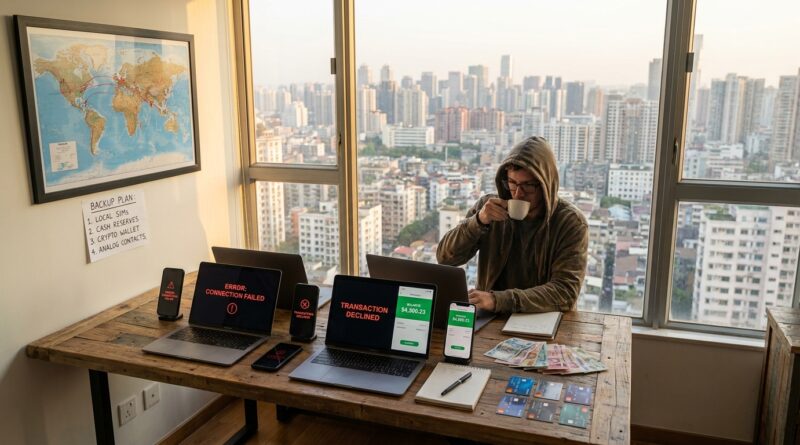
The New ‘Bank Outage Survival Stack’: How Nomads Can Keep Cash Flowing When Your App Goes Dark Overnight
You do not need a total money meltdown for a bank outage to ruin your day. Sometimes it is smaller and somehow worse. You are in a new city, your hotel wants payment, your coffee card declines, and your main banking app just sits there spinning like it forgot you exist. That is not just annoying. It is stressful, especially if your whole setup depends on one bank, one broker, one card, and one phone. Over the last day, several major financial platforms have had outages or partial failures. That is the reminder a lot of digital nomads and FI-minded travelers needed. A digital nomad banking outage backup plan is no longer a paranoid extra. It is basic travel gear, like carrying a charger or having travel insurance. The good news is you do not need a complicated system. You need a small, boring, reliable backup stack that keeps cash moving when the shiny app goes dark.
⚡ In a Hurry? Key Takeaways
- Your safest move is to split money access across at least two banks, two cards, and some local cash.
- Keep one emergency fund account separate from your daily spending app, and test your backups before you travel.
- Outages are not rare edge cases anymore. A little redundancy can save rent, flights, and a lot of panic.
Why this matters more than it used to
A few years ago, a banking outage felt like a nuisance. Now it can freeze your life.
Digital nomads often run everything through a small set of apps. Income lands in one account. Bills auto-pay from another. Investments live in one broker. Spending happens on one travel-friendly card. That setup is clean and efficient, right up until one part fails.
And when it fails abroad, the problem gets bigger fast. Support lines are jammed. Time zones are working against you. Your landlord does not care that your app is down. Neither does the airline holding a good fare for the next 20 minutes.
The lesson is simple. Convenience is great. Concentration risk is not.
The new bank outage survival stack
You do not need ten accounts and a spreadsheet that looks like a flight dashboard. You need layers. Think of it like packing backups for money access.
Layer 1: Your primary spending account
This is the account and card you use most days. It should have low fees, good fraud controls, and easy international use. Keep enough here for regular life, but not every dollar you own.
Layer 2: A second bank on a different system
This is the heart of a good digital nomad banking outage backup plan. Your backup bank should not be a second product from the same parent company if you can help it. If one platform has a technical issue, related services can sometimes wobble too.
Use a different bank with its own app, cards, and transfer rails. Keep enough there to cover at least one to two weeks of normal spending, plus one ugly surprise like a last-minute flight or a security deposit.
Layer 3: Two physical cards, stored separately
One card in your wallet. One card in your bag or accommodation safe. Ideally from different banks and different card networks if possible.
If your main Visa debit card fails because of an outage, a Mastercard credit card from another issuer might still work. Do not store both in the same place unless you enjoy losing both at once.
Layer 4: Local cash
Yes, actual paper money. Not a fortune. Just enough to get through 24 to 72 hours.
That means food, transit, one night of lodging if things go sideways, and maybe a taxi when your phone battery is limping along at 6 percent. In some places, cash is still the fastest way to solve a problem. During an outage, it can be the only way.
Layer 5: An emergency reserve that is not part of your daily flow
This is your break-glass money. Keep it in a separate account that is easy enough to reach, but not tied to your daily spending setup. The goal is simple. If your main app is down, locked, or frozen for fraud review, your emergency cash still exists in a different lane.
What your backup plan should include
1. Two banks, not just two accounts
This is the biggest mistake people make. They think they are diversified because they have checking and savings. If both live under the same login and same bank infrastructure, that is not much of a backup.
A better setup is:
- Bank A for income and daily spending
- Bank B for backup cash and a separate card
- Optional broker or cash management account for a third lane, but not your first backup
2. One debit card and one credit card
Debit cards pull from cash you already have. Credit cards can keep life moving while transfers catch up. Both matter.
Use the credit card as a bridge, not a lifestyle. If your bank transfer is delayed, your credit card can still cover a hotel, meal, or ticket while you sort things out.
3. Offline copies of the important stuff
If your app is down, you may still need account numbers, support phone numbers, card freeze instructions, or transfer details.
Keep a secure offline record of:
- Bank and card support numbers
- Last four digits of your cards
- IBAN or account numbers for backups
- Broker account support details
- A list of automatic bills and due dates
Do not keep full sensitive details in plain text on your phone. Use a password manager with offline access enabled, or a secure encrypted note.
4. A tested transfer path
This one matters more than people think. It is not enough to have a second account if moving money between accounts takes three days, requires a text code to an old SIM, or only works during bank business hours back home.
Before you travel, test a small transfer from your main account to your backup account and back again. Time it. Know the friction points. Find out what breaks while you are calm, not when your cab driver is waiting for payment.
5. A local payment fallback
Depending on where you travel, this could mean a local prepaid SIM-linked wallet, a local bank account, or a trusted remittance option. You do not need this everywhere. But if you stay long term in one country, a local payment rail can be a lifesaver when your home-country apps are having a bad day.
How much backup cash should a nomad keep?
A simple rule works well. Keep enough accessible backup money to cover 7 to 14 days of core life.
That usually means:
- Housing or a short lodging bridge
- Food
- Transit
- Phone data
- One urgent travel expense
If your life is more complex, bump it up. If you have dependents, medical needs, or expensive border runs, your number should be higher.
The point is not to hoard cash in random places. The point is to buy time.
What to do the moment your bank app goes down
Step 1: Confirm it is not just your device
Try a browser. Try another connection. Check the bank’s status page if it has one. Look at reliable outage reports. Sometimes the bank is down. Sometimes your hotel Wi-Fi is just dramatic.
Step 2: Stop retrying the same failing payment
Repeated attempts can trigger fraud flags or duplicate holds. If a payment fails, pause and switch methods rather than hammering refresh like it owes you rent.
Step 3: Move to your backup rail
Use your second card. Use cash. Use your backup bank. This is exactly why it exists.
Step 4: Protect your important deadlines
If rent, lodging, or a flight is time-sensitive, communicate early. A quick message buys goodwill. “My bank is having an outage. I can pay via alternate method in two hours” sounds a lot better than silence.
Step 5: Document anything messy
Take screenshots. Save failed transaction messages. Keep receipts if you had to use a more expensive workaround. If fees or duplicate charges show up later, records help.
Common weak spots people forget
Two-factor authentication tied to one phone number
If your bank sends codes only to one SIM you no longer have access to, your backup may not really be a backup. Set up authenticator apps where possible and make sure recovery methods work abroad.
All cards in one wallet
This is not redundancy. This is a group project where everybody fails together.
Broker accounts that are rich on paper but poor in real life
A large portfolio does not help if selling takes time, transfers are delayed, or the platform itself is struggling. Investment accounts are not the same thing as spending access.
No cash because “everywhere takes cards now”
Until they do not. Or until your card does not.
A low-friction setup most people can actually maintain
If you want something practical, start here:
- One main checking account for income and bills
- One backup bank account at a different institution with a small emergency balance
- One debit card and one credit card from different issuers
- Cash for two or three days of basic expenses
- Offline access to support numbers and account basics
- A tested transfer route between accounts
That is it. Nothing fancy. Just enough separation that one outage does not freeze your whole life.
The mindset shift FI readers should make
If you are focused on financial independence, it is easy to think mostly about returns, expense ratios, tax efficiency, and long-term runway. All important. But operational resilience matters too.
Your plan should survive real life, not just work beautifully in a spreadsheet. A banking outage is not the end of the world. But it can become an expensive distraction if all your money tools live in one digital basket.
At a Glance: Comparison
| Feature/Aspect | Details | Verdict |
|---|---|---|
| Single-bank setup | One app, one card, one login. Easy to manage, but one outage can block spending and transfers. | Too risky for cross-border living |
| Two-bank backup system | Separate institutions, separate cards, small emergency float, tested transfers. | Best balance of safety and simplicity |
| Cash-only emergency stash | Useful for short disruptions, taxis, and meals, but limited for rent or travel rebooking. | Good supplement, not a full plan |
Conclusion
Over the last 24 hours, multiple major banking and financial platforms have shown exactly how fragile app-only money access can be. For digital nomads and FI-focused readers, that is the real takeaway. Single-point-of-failure banking is not a theory anymore. It is an operational risk. The fix does not need to be complicated or expensive. A second bank, a second card, some local cash, offline account access, and one tested backup route can keep your cash flow alive across borders when the status page turns red. Set it up once, test it while things are calm, and future-you will be very glad you did the next time your main app decides to take the morning off.