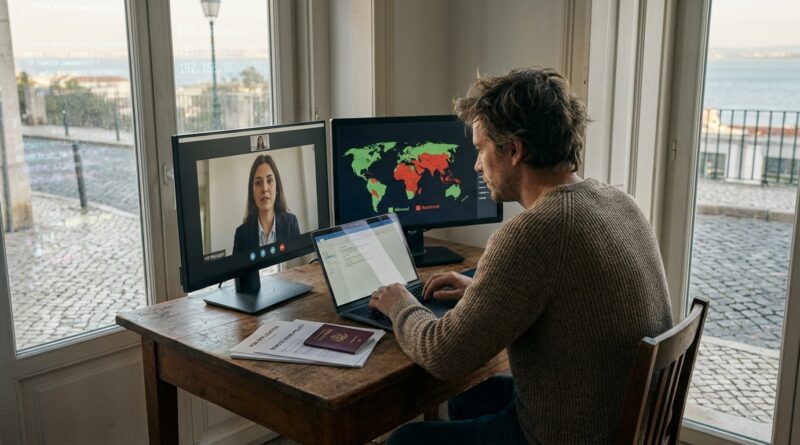
The New ‘Stealth Compliance Check’: How Nomads Can Work Abroad Without Triggering HR Or Killing Their FI Plan
You finally found the math that makes your FI plan work. Keep your salary from a higher-cost country, live somewhere cheaper, bank the difference, repeat. Then HR updates the remote work policy to “home state only,” your manager starts asking where you are, and you realize this whole setup may depend on nobody looking too closely. That is a stressful place to be.
If you are asking, “can i work remotely from another country without my employer knowing,” the honest answer is this. Maybe for a while, but it is getting riskier fast. Companies now have more ways to spot it, from login location checks to payroll audits to social media clues. Governments are also paying more attention to visa misuse and tax residency. If your paycheck is the engine of your financial independence plan, stealth is a shaky foundation. A better plan is to know where the real tripwires are, reduce avoidable risk, and if possible get written approval before your low-cost paradise turns into a payroll, tax, or immigration mess.
⚡ In a Hurry? Key Takeaways
- You can sometimes work abroad without your employer noticing at first, but it can still break company policy, visa rules, tax rules, or all three.
- Before you go, check your contract, tax residency rules, visa terms, payroll impact, and how your company tracks logins and locations.
- The safest FI move is not “be invisible.” It is choosing setups with clear permission, short stays, or legal structures that do not put your salary at risk.
The stealth nomad era is getting harder
For years, a lot of remote workers got away with a simple system. Bring the laptop, keep U.S. hours, use a VPN, tell almost no one. It felt harmless. You were still doing your job. Your employer still got the work.
The problem is that companies and governments do not see it that way.
Employers worry about tax nexus, labor law, data security, export controls, benefits, insurance, and payroll compliance. Governments worry about people entering on tourist status while quietly working online. Neither side cares much that you are trying to lower your burn rate and reach FI faster.
That gap matters. A lot.
So, can you work remotely from another country without your employer knowing?
Yes, in the narrow sense that some people do it and are not caught right away.
No, in the practical sense that “not caught yet” is not the same as “safe.” If you depend on this income, the better question is not whether it is possible. It is whether the downside is acceptable.
What can go wrong
A hidden work-abroad setup can trigger problems in four separate buckets:
- Company policy. You may be violating your employment agreement, security policy, or remote work rules.
- Immigration law. Tourist visas often do not clearly allow remote work, even if the employer is abroad.
- Tax residency. Stay long enough and you may create a tax filing duty for yourself. In some cases, your employer may face exposure too.
- Payroll and benefits. Health coverage, workers comp, and state payroll registrations may not work the way you think once you leave your approved location.
Any one of these can spoil the geo-arbitrage win.
Why employers are quietly cracking down
This is not just boss paranoia. There are real headaches for companies.
Payroll and tax risk
If an employee works in a place where the company is not registered, that can create reporting or withholding issues. Even a short stint can trigger questions, especially if it becomes a pattern.
Security and customer contracts
Many companies promise clients that data will be accessed only from certain countries or only by employees working inside approved regions. If you log in from elsewhere, the company may be breaking its own contracts.
Labor law mess
Employment rules differ by country and sometimes by state. Overtime, termination protections, required leave, and employer obligations can shift depending on where the work is physically done.
Insurance gaps
Travel medical insurance is not the same as employer health coverage. Workers comp may not protect you overseas. Cyber insurance may also have location restrictions.
How companies may spot a “stealth compliance check”
This is the part many people underestimate.
IP address and login location
Your company VPN, Microsoft 365, Google Workspace, Slack, Okta, and endpoint security tools can all log where access appears to come from. Even if you use a personal VPN, mistakes happen. One login without it is enough to start questions.
Time zone mismatch
Meeting availability, delayed replies, and log timestamps can tell a story. If you always seem oddly active at 2 a.m. home time, people notice.
Expense reports and card use
Corporate card charges, reimbursement receipts, and even meal stipends can reveal location.
Social media and public clues
That beach photo with a location tag. The “hello from Lisbon” post. The local SIM screenshot. You would be surprised how often this is what blows the cover.
Manager gossip and casual slips
Most people do not get caught by a hacker-grade tracking system. They get caught because they mention a visa run, complain about local internet, or appear in a team call with palm trees behind them after saying they are in Ohio.
What matters most for FI-minded readers
If you are building financial independence, your salary is not just monthly income. It is the machine buying freedom. That means protecting income matters more than squeezing out every last dollar of location arbitrage.
A setup that saves you $1,500 a month but puts a six-figure career at risk is not automatically a smart trade.
Think in terms of expected value, not best-case savings.
A simple risk ladder for working abroad
Lowest risk
You have written employer approval, a visa or legal status that allows your situation, short stays or clear tax guidance, and no hidden location tricks.
Medium risk
Your company informally knows, your stay is short, and you have checked tax and visa basics, but nothing is formally documented.
High risk
Your contract says home state only, you are using a VPN to hide location, you are on a tourist status with blurry work rules, and you plan to stay long enough to look settled.
If you are in the high-risk bucket, your FI plan is resting on luck.
How to lower the risk without giving up the dream
1. Read the boring documents
Start with your offer letter, employee handbook, remote work policy, data security policy, and any travel or expense policy. Search for terms like “work location,” “tax,” “outside the country,” “approved jurisdictions,” and “VPN.”
This is dull. It is also where the real answer usually lives.
2. Know the difference between short travel and living somewhere
A two-week working trip is one thing. Spending four months in another country while renting an apartment and posting your new routine online is another. The longer and more settled it looks, the harder it is to argue it was casual travel.
3. Check visa rules before tax rules, not after
Many nomads focus on taxes first because tax blogs are easier to find. Fair enough. But immigration is often the more immediate risk. If your entry status does not allow your activity, the tax analysis will not save you.
4. Watch the tax residency clock
Each country has its own rules, and they are not all based only on 183 days. Some look at ties, habitual abode, or local-source work. U.S. state tax issues can also follow you if you keep a domicile there.
If your FI plan depends on precision, talk to a cross-border tax pro before you become “accidentally resident.”
5. Be careful with VPN logic
A VPN may hide some traffic. It does not fix immigration status, tax residency, payroll exposure, or policy violations. It is a privacy tool, not a legal permission slip.
6. Consider asking for a bounded exception
A lot of employers will reject “I want to live anywhere indefinitely.” Some will approve “I want to work from Portugal for three weeks while visiting family” or “Can I do up to 30 days a year from approved countries?”
Small asks often do better than big asks.
7. Pick nomad-friendly countries on purpose
Some countries now offer digital nomad visas or clearer remote-work paths. They may cost more than flying in as a tourist and hoping for the best, but clarity has value. Especially when your income stream matters.
8. Separate your dream plan from your current job
If your employer is strict, do not force a lifestyle that only works by breaking rules. You may need a different employer, contractor status, a location-flexible role, or a slower transition. That is frustrating, but it is better than waking up to an HR meeting invite and a disabled laptop.
If you decide to tell your employer, say it the smart way
Do not frame it as, “I already booked flights and found a loophole.”
Frame it as risk management.
What to include
- The exact country and dates
- Your working hours and how you will stay available
- Whether you will access sensitive systems
- That you are asking for approval before making plans
- A willingness to limit the trip or choose a different location if needed
This tells HR and legal you are not trying to create surprise problems for them.
Red flags that mean “do not wing this”
- Your company has clients in health care, finance, government, defense, or other regulated fields
- Your contract says you must work from a specific state or country
- You handle customer data, source code, or export-controlled information
- You plan to stay abroad for months, not weeks
- You need to hide your location to make the plan work
- You are relying on a tourist visa because “everyone does it”
These are not little technicalities. These are clues that the downside could be serious.
What a practical “safer” version can look like
Option 1. Approved short stays
You stay under your employer’s stated limit and choose countries they allow. Less exciting than full-time nomad life, but much safer.
Option 2. Change jobs before you change countries
Find an employer that already supports cross-border remote work. This takes patience, but it aligns your income with your lifestyle instead of forcing them to fight each other.
Option 3. Move to contractor or EOR arrangements
Sometimes the cleanest path is to work through a legal structure designed for international arrangements. It may cost more. It may also preserve the income stream that funds your FI number.
Option 4. Build a longer runway
If your current job cannot support this life, use it for one more year to bulk up savings, then switch with a bigger cushion. Not glamorous. Very effective.
The question most people are really asking
Usually this is not just about hiding from an employer. It is about fear that the only way to make the numbers work is to bend the rules a little.
I get it. Housing is expensive. FI math can feel brutal. And geo-arbitrage really can make a huge difference.
But the old playbook of “just do it quietly” works worst for the people with the most to lose. If your plan depends on a stable salary, your first job is protecting the salary.
At a Glance: Comparison
| Feature/Aspect | Details | Verdict |
|---|---|---|
| Hidden work abroad | May go unnoticed for a while, but can break company policy, visa terms, and tax rules. Detection risk is rising. | High risk for anyone depending on the job |
| Employer-approved short stay | Clear dates, approved country, limited duration, better fit for payroll and security reviews. | Best balance for most employees |
| Long-term nomad setup with legal structure | Uses proper visa, tax planning, and possibly contractor or employer-of-record support. | Safest long-term option, but more effort and cost |
Conclusion
The hard truth is that there is now a bigger gap between how many digital nomads actually live and what employment contracts and visa rules technically allow. That gap used to be easier to ignore. It is not anymore. Companies are adding IP checks, policy reviews, and sometimes even social media monitoring. Governments are doing more online vetting too. So if your FI plan depends on keeping a good salary while living cheaply abroad, “no one will notice” is not much of a strategy. The good news is you still have options. You can ask for narrow approval, choose countries and timelines more carefully, get proper tax advice, or shift into a job structure that fits the life you want. The goal is not to kill the geo-arbitrage advantage. It is to keep it without blowing up your paycheck, your legal status, or your long-term plan.