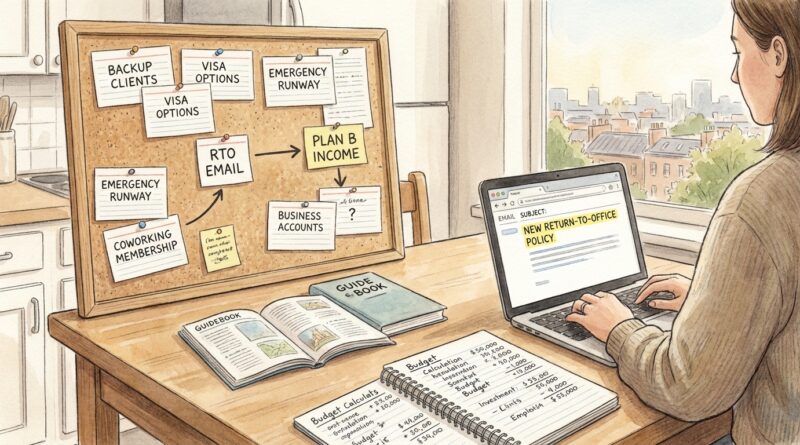
The New ‘Remote Reversal Backup Plan’: How Digital Nomads Can Stay Location‑Free When Your Employer Kills WFH Overnight
You are not overreacting if the recent return-to-office headlines have you feeling a little sick. A lot of digital nomads built their lives around one shaky promise, that “remote” would stay remote. Then a new manager shows up, a company misses targets, or HR decides culture is best built under fluorescent lights, and suddenly your beach apartment, visa run, or long-term Airbnb plan looks fragile. That is the real problem here. It is not just inconvenience. It is income risk, housing risk, and freedom risk all bundled together. The fix is not panic. It is a remote reversal backup plan. Think of it like an emergency parachute for your work life. You hope you never need it. But if your employer kills work from home overnight, having one ready can save months of stress, rushed travel, and expensive bad decisions.
⚡ In a Hurry? Key Takeaways
- Your best digital nomad backup plan for return to office policies is to prepare before the policy changes, not after.
- Start with a 3-layer backup: cash buffer, job options, and a fast housing/travel fallback.
- The goal is not to predict your employer. It is to make sure one policy change does not wreck your income or autonomy.
Why this risk matters more than people want to admit
For years, “remote-friendly” often meant “good enough for now.” That worked while companies were trying to hire fast and keep workers happy. It works a lot less well when leadership changes its mind.
The hard part is that many workers do not notice how exposed they are until the email lands. It usually sounds polite. More collaboration. Better alignment. Stronger in-person culture. Then comes the part that matters. Three days a week in office. Maybe four. Maybe a required move back to a specific city.
If your rent, travel schedule, tax setup, or family life depends on being location-free, that kind of policy can hit like a truck.
What a “Remote Reversal Backup Plan” actually means
This is not a dramatic escape plan. It is a simple pre-mortem. You ask one question before trouble starts.
“If my employer ended work from anywhere next month, what would I do in the first 72 hours, first 30 days, and first 90 days?”
That question forces you to replace hope with options.
The 72-hour plan
This is about stopping chaos. You need to know:
- Whether your role is officially remote, hybrid, or just “manager approved”
- What city your employer considers your home office
- How long you could realistically stall before making a move
- Where you would stay if you had to return quickly
The 30-day plan
This is about preserving income. You should know:
- How much cash you need to bridge one to three months
- Whether you could negotiate an exception
- Which employers you could apply to immediately
- What expenses you would cut first
The 90-day plan
This is about rebuilding freedom. You decide whether to:
- Stay and adapt temporarily
- Switch to a more remote-stable employer
- Move into contract or freelance work
- Restructure your lifestyle around lower fixed costs
Step 1: Check whether your “remote job” is actually protected
This part is boring. It is also where most people get surprised.
Look at your offer letter, employee handbook, HR portal, and any written approvals. You are checking for one thing. Is your remote status documented, or is it just the current habit?
There is a big difference between:
- “This position is fully remote”
- “Employee may work remotely with manager approval”
- “Employee is assigned to X office but currently works offsite”
Only the first one offers much real protection, and even that can still change. If your setup is fuzzy, assume it can be reversed faster than you would like.
Step 2: Build a “badge swipe buffer” in cash
If your employer suddenly wants you back in an office city, money buys time. Time buys choices.
Your backup fund should cover more than normal emergency spending. For this specific risk, include:
- Last-minute flights
- Temporary housing in your employer’s city
- Higher transport costs
- Storage, pet care, or moving expenses
- A few months of overlap if you need to keep two setups briefly
A regular emergency fund is good. A return-to-office fund is better. Try to separate it mentally, even if it sits in the same savings account.
A practical target
Many nomads should aim for one of these:
- Minimum: enough for an urgent return and 30 days of stable housing
- Better: 3 months of core living costs plus relocation costs
- Best: 6 months of living costs if your role or industry is getting less remote-friendly
Step 3: Keep a “go bag” for your career, not just your passport
If things change fast, the people who recover quickest are usually the people with documents, contacts, and work samples ready.
Create a simple folder with:
- Your updated resume
- A short bio and LinkedIn summary
- Portfolio links or work samples
- A list of references
- Copies of certifications
- A spreadsheet of remote-friendly employers and recruiters
This sounds obvious. Yet many people only update this stuff after they are already stressed.
Step 4: Rank your employer on “remote stability,” not remote branding
Some companies talk endlessly about flexibility and still pull people back. Others quietly leave remote teams alone for years. Pay attention to behavior, not slogans.
Green flags
- Remote status is written into job postings and contracts
- The company hires across many regions by design
- Managers are remote too
- Promotion paths exist for fully remote staff
- The company has closed or reduced office footprint
Yellow flags
- Leadership keeps talking about “reconnecting in person”
- New executives come from office-heavy companies
- Remote workers are left out of high-visibility work
- Job listings quietly shift from remote to hybrid
Red flags
- Your office assignment still exists on paper
- Exceptions are manager-based instead of policy-based
- There are recent attendance crackdowns in other departments
- Government contracts, regulated work, or security rules are tightening location requirements
Step 5: Create a two-track housing plan
This is where digital nomads often get trapped. They optimize for adventure and low cost, but not for fast reversals.
Your backup plan should include:
Track A: “Stay nomadic” option
If your job goes hybrid, can you move to a nearby lower-cost city and commute part-time? Can you switch countries or regions without breaking your budget? Can you pause long leases quickly?
Track B: “Return fast” option
If you had to be near an office in two weeks, where would you go? A family spare room. A friend’s place. A month-to-month rental. A short-stay apartment.
You do not need to book anything now. You just need a realistic map of your fallback choices.
Step 6: Build a second income lane before you need it
If one employer controls both your paycheck and your location freedom, that is more risk than most people realize.
A second income lane can be tiny at first. The point is not to replace your salary tomorrow. The point is to reduce panic if policy changes.
Good options include:
- Freelance work in your existing skill set
- Contract work with remote-first teams
- Advising, coaching, or technical consulting
- Small digital products or a niche newsletter
Even a modest side income can help you say, “No, I am not moving back on bad terms just to keep the lights on.”
Step 7: Quietly test the job market now
You do not need to quit. You do need information.
Once a quarter, do a soft market check:
- Apply to two or three remote roles
- Reply to one recruiter
- Ask contacts which companies still support location freedom
- Note whether salaries and remote terms are improving or shrinking
This gives you a live read on your options. It also keeps your interviewing muscles from getting rusty.
Step 8: Prepare your negotiation script before the bad news arrives
If your employer announces a return-to-office policy, your first call or email matters. Stress makes people ramble. Better to have a calm script ready.
What to ask for
- A grandfathered exception based on your current location
- A longer transition period
- Quarterly travel instead of weekly attendance
- A role transfer into a fully remote team
- Written clarification of expectations before you make any move
A useful tone
Keep it practical, not emotional. Try something like:
“I want to keep performing at a high level, but my current location setup was built around my approved remote arrangement. Before I make any major housing or travel decisions, can we review whether there is an exception path, a longer transition window, or an alternative team structure?”
You are not begging. You are buying time and clarity.
What not to do
A few mistakes make this situation worse fast.
- Do not assume “they would tell us early.” Sometimes they will not.
- Do not sign long leases based only on current policy. Especially in expensive cities or overseas.
- Do not let your remote network go stale. Most good remote roles come through people.
- Do not wait for certainty. By the time a policy is certain, your choices may be worse.
A simple remote reversal checklist
If you want a one-page version of this, here it is:
- Confirm your remote status in writing
- Save enough for a forced return and 1 to 3 months of housing
- Update your resume, portfolio, and references
- Make a list of 20 remote-friendly employers
- Identify one fast return housing option
- Start one side income stream
- Do quarterly job-market checks
- Write your negotiation script now
At a Glance: Comparison
| Feature/Aspect | Details | Verdict |
|---|---|---|
| Cash Backup | Covers emergency travel, temporary housing, and a few months of living costs if remote work is reversed. | Essential. This is what turns a crisis into a manageable problem. |
| Career Backup | Updated resume, references, portfolio, recruiter contacts, and a live list of remote-first employers. | High value. Gives you options before you are desperate. |
| Housing and Travel Backup | Pre-picked fallback locations, short-term stay options, and a practical plan if you must return near an office quickly. | Often overlooked. Very important for digital nomads. |
Conclusion
The recent drumbeat of return-to-office stories is a warning shot for anyone building financial independence around location freedom. That does not mean the dream is dead. It means the dream needs a backup plan. A smart digital nomad backup plan for return to office policies is not about fear. It is about staying hard to corner. If your employer tightens attendance rules or kills fully remote work, you want savings, housing options, and job options ready before the panic starts. That protects your income, your autonomy, and your ability to keep moving toward FI without one executive memo blowing up your life. Freedom is still possible. Just do not leave it sitting on one policy you do not control.