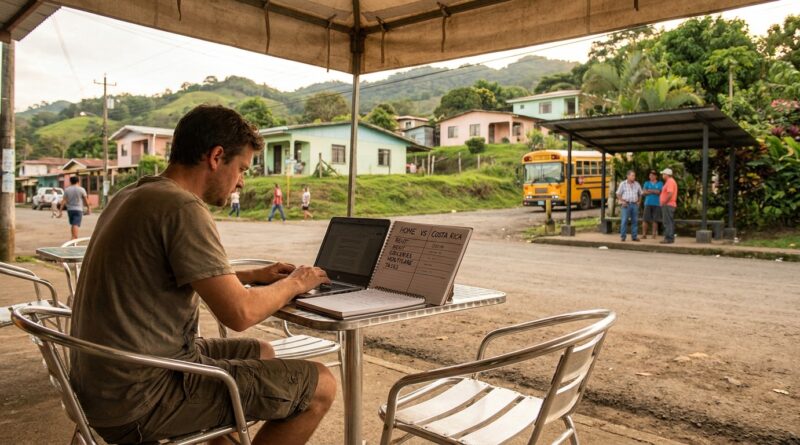
The New ‘Costa Rica Relocation Compass’: How To Turn Today’s Rankings Into A 5‑Year Plan B For Your FI Life
You are not crazy for side-eyeing those “best places to move” lists. Most of them are built to sell a dream, not help you make a decision. A beach photo is nice. It does not tell you what happens when rent jumps, your internet cuts out during work, or you realize imported groceries cost more than you expected. If you are thinking about Costa Rica, the real question is not “Is it beautiful?” It is “Can this work as a five-year Plan B for my financial independence life?” That is a very different test. Costa Rica keeps showing up in digital nomad and relocation rankings for good reasons. It has political stability, decent private healthcare, established expat areas, and enough infrastructure to make a trial move realistic. But rankings are only a starting point. The useful move is to turn broad praise into a personal scorecard, then into a phased plan that protects your money, your options, and your sanity.
⚡ In a Hurry? Key Takeaways
- Costa Rica can be a solid Plan B for financial independence, but only if you test real costs, residency options, healthcare, taxes, and location fit instead of trusting rankings.
- Start with a five-year plan: research in year one, do a 30 to 90 day stay in year two, run a trial budget in year three, build legal and tax backups in year four, and decide in year five.
- The safest approach is a phased move, not a dramatic one-way ticket. Keep cash reserves, keep U.S. ties where needed, and pressure test every assumption before you commit.
Why Costa Rica keeps landing on these lists
There is a reason Costa Rica gets attention. It offers a mix many people want right now. Relative political stability. Familiarity for U.S. travelers. Good private healthcare options. Strong tourism infrastructure. A large enough expat and remote-worker presence that you do not have to invent your own support system.
That matters if your goal is not adventure for adventure’s sake. It matters even more if you are trying to reduce risk while protecting your path to financial independence.
Still, list rankings can blur important details. “Affordable” compared with New York or San Francisco does not mean cheap. “Good internet” in one town does not mean reliable internet in another. “Easy relocation” can mean “easy for a tourist” rather than “easy for a household trying to build a sustainable life.”
What rankings are actually useful for
Treat rankings like a weather forecast. Helpful, but not enough to plan your whole life around. A country doing well in relocation or digital nomad lists usually signals a few things:
- It is already on the radar for remote workers and expats.
- There is probably some visa or residency path worth checking.
- Infrastructure is at least decent in popular areas.
- There is enough demand that housing and services may be easier to find, but sometimes more expensive too.
That is the cue to start your own math. Not stop there.
Turn “Costa Rica sounds promising” into a five-year Plan B
Year 1. Build your Costa Rica reality check
Start with the basics. Pick three places, not one. For example, you might compare San José suburbs, the Central Valley, and a beach town like Tamarindo or Santa Teresa. This matters because “Costa Rica” is not one uniform cost or lifestyle.
Create a simple spreadsheet with these categories:
- Rent for your housing style
- Groceries, local and imported
- Healthcare and insurance
- Transportation, car, buses, rideshare, fuel
- Internet and mobile plans
- Taxes and legal fees
- Flights back to the U.S.
- Emergency reserve needs
Then compare your current U.S. monthly burn rate to a likely Costa Rica burn rate. Do not use “best case” numbers. Use realistic ones from recent rentals, current grocery reports, and expat forums that discuss real bills, not dream life fantasy budgets.
Year 2. Do a test stay, not a life reset
This is where many people either get clarity or save themselves from a bad move. Spend 30 to 90 days there if you can. Work normal hours if you still earn remotely. Cook at home. Use the healthcare system for something basic. Check the internet when it rains. See how it feels to deal with errands, traffic, language gaps, and utility issues.
Vacation Costa Rica and everyday Costa Rica are not the same thing. That is not a criticism. It is just reality.
Year 3. Run a parallel budget
Even if you stay in the U.S. for now, start living on your projected Costa Rica budget for six months. If your estimated spend is $3,200 a month there, live on that amount now and divert the difference into a dedicated “Plan B fund.”
This does two useful things. First, it tests whether your estimate is actually workable. Second, it builds the cash cushion that makes future choices less stressful.
A good target is enough to cover relocation costs, deposits, legal help, flights, and six to twelve months of living expenses. If that number feels high, good. That means you are planning for real life.
Year 4. Sort out taxes, residency, and healthcare
This is the boring part, which usually means it is the important part.
Look into Costa Rica’s digital nomad route and any longer-term residency options that fit your situation. Rules change, so verify current details with official sources and a qualified immigration professional before acting.
At the same time, speak with a tax pro who understands U.S. expats. U.S. citizens usually still have U.S. filing obligations even if they live abroad. That does not automatically make a move a bad idea. It just means the “I’ll save so much money” story has to include compliance costs and tax reality.
Healthcare deserves the same treatment. Costa Rica often scores well for private healthcare access and quality, especially in major areas. But your personal answer depends on age, pre-existing conditions, drug availability, insurance costs, and how close you want to be to certain specialists.
Year 5. Choose your lane
By this point, you should be able to make one of three smart decisions:
- Move in phases and keep the U.S. as your anchor for a while.
- Commit to a one-year relocation experiment with clear exit criteria.
- Say no, and feel good about that no because you actually did the work.
That last option matters. A Plan B is successful if it gives you clarity, not only if it ends with you moving.
Where Costa Rica can help a FI plan
Lower spending, sometimes
If you are coming from a high-cost U.S. city, Costa Rica can lower your housing and daily living costs, especially outside the most tourist-heavy pockets. That can extend runway, reduce annual drawdown, or let part-time work cover more of your needs.
But watch the trap. Some beach towns and expat-heavy areas can get expensive fast. Imported products, private school costs, cars, and premium rentals can erase the savings people assume they will get.
Better optionality
A Plan B is about flexibility. If the U.S. feels more expensive, more fragile, or simply less aligned with your goals, having another workable location gives you more room to breathe. Even the knowledge that you could move changes how trapped you feel.
Quality of life
This is harder to model, but it counts. A slower pace, more time outside, less pressure to consume, and easier access to nature can make a big difference. Financial independence is not just a spreadsheet target. It is also about building a life you want to wake up to.
Where Costa Rica can disappoint people
It is not as cheap as the fantasy version
This is probably the biggest gap between rankings and reality. Costa Rica often costs more than people expect, especially compared with other Latin American options. You are paying for stability, popularity, and infrastructure. That may still be worth it. Just do not confuse “cheaper than my current ZIP code” with “dirt cheap.”
Infrastructure is uneven
You can find reliable internet and solid services in many areas. You can also find potholes, slow bureaucracy, power issues, and regional differences that become annoying when they hit your daily routine. If your income still depends on remote work, this deserves real testing.
You are still moving your life
This sounds obvious, but it gets lost in relocation content. You are not just buying lower rent. You are changing legal systems, healthcare habits, transportation norms, and your social life. Even good changes take energy.
A simple scorecard for your own decision
Give Costa Rica a score from 1 to 5 in each category below. Then score your current U.S. setup the same way.
- Total monthly cost
- Healthcare access
- Tax simplicity
- Internet and work reliability
- Personal safety and comfort
- Language and culture fit
- Climate and daily lifestyle
- Travel access to family
- Residency and legal clarity
- Exit flexibility if things change
If Costa Rica wins on lifestyle but loses badly on taxes, healthcare, or reliable housing, that is your clue to test longer before making a leap. If it wins on eight out of ten and your numbers hold up, you may have a serious candidate for a Plan B.
Red flags to watch before you move
- You only have tourist-budget numbers, not resident-budget numbers.
- You are assuming healthcare will be easy without checking your specific needs.
- You need perfect internet but have not tested your exact neighborhood.
- You are counting on lower costs while choosing one of the priciest expat beach towns.
- You have not priced legal help, flights, deposits, and setup costs.
- You are using relocation as an emotional escape rather than a planned financial move.
If you want the safest version of this plan
The safest version is boring, and that is a compliment.
Rent, do not buy, at least at first. Keep a U.S. mailing address and banking setup where appropriate. Keep a bigger cash reserve than you think you need. Visit in different seasons. Test both a city base and a leisure-heavy area. Make sure at least one local professional can explain the current visa, tax, and healthcare setup in plain English.
Most of all, do not make Costa Rica carry more emotional weight than it should. It does not need to be your forever home to be useful. It only needs to be a credible option that improves your resilience and gives you more control.
At a Glance: Comparison
| Feature/Aspect | Details | Verdict |
|---|---|---|
| Cost of Living | Often lower than many U.S. cities, but not uniformly cheap. Tourist and expat hotspots can be pricey, especially for imported goods and premium rentals. | Potential win, but only with location-specific budgeting. |
| Infrastructure and Daily Practicality | Decent private healthcare and workable internet in many areas, but quality varies by town and neighborhood. | Good enough for many remote workers, not something to assume blindly. |
| FI Plan B Suitability | Strong as a phased backup option if you value stability, access, and a softer lifestyle more than rock-bottom costs. | Best for planners who test first, not impulse movers. |
Conclusion
Right now, plenty of U.S.-based readers are quietly asking the same question. Does staying put still make sense if places like Costa Rica are climbing relocation and digital nomad rankings while offering a gentler cost of living and decent infrastructure? The useful answer is not yes or no. It is “run the numbers properly.” A Costa Rica digital nomad financial independence plan B can absolutely make sense, but only when you translate list-friendly buzz into your own five-year map. That means testing real costs, checking legal and tax details, and seeing whether the day-to-day life fits the life you are trying to build. Done well, this kind of planning stops the doom scrolling. It gives you something better. A clear decision. Maybe that decision is a phased move. Maybe it is a trial year. Maybe it is a firm no. Any of those outcomes can move you closer to autonomy if they are based on evidence instead of fantasy.