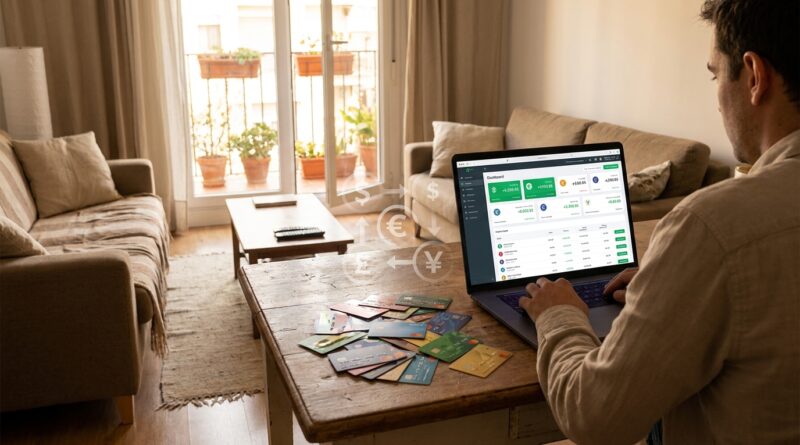
The New ‘Nomad FX Firewall’: How To Stop Foreign Transaction Fees Quietly Killing Your FI Plan
You did the hard part. You built income that travels, packed up your life, and started living abroad. Then the tiny cuts began. A card gets hit with a “foreign transaction fee.” An ATM adds its own surprise charge. A “fee-free” app gives you a rotten exchange rate that quietly skims 2 to 3 percent anyway. It feels small in the moment. It is not small over a year. For digital nomads aiming for financial independence, this is one of the sneakiest leaks in the whole system. The fix is not some magic card. It is a payment setup. Think of it like a firewall for your money. You want one account for getting paid, one or two cards for spending, a local cash option, and a rule for when to convert currency and when not to. Set it up once, then let it protect every swipe.
⚡ In a Hurry? Key Takeaways
- The best payment setup for digital nomads to avoid foreign transaction fees is a simple stack: one low-cost multi-currency account, one true no-FTF credit card, one backup debit card, and a habit of always paying in local currency.
- Start by checking three things today: foreign transaction fee, exchange rate spread, and ATM policy. A card with “no fee” can still be expensive if the spread is bad.
- Do not trust any single app, crypto card, or bank as your whole system. Redundancy matters more than hype when you are overseas.
What the “Nomad FX Firewall” actually means
This is not a product. It is a way to arrange your money so one bad fee policy cannot wreck your budget.
The idea is simple. Put a barrier between your income and the random fees that show up when you live internationally. Your setup should do four jobs well:
- Receive money in a stable, low-fee way.
- Convert currency at a fair rate.
- Handle daily spending without foreign transaction fees.
- Give you backups when a card gets blocked, lost, or starts charging nonsense.
If you only have one bank card from home, you do not have a setup. You have a single point of failure.
The quiet ways foreign transaction fees drain your FI plan
1. The obvious fee
This is the classic 1 to 3 percent foreign transaction fee added by many banks and cards. It is easy to miss because it gets buried in your statement.
2. The hidden FX spread
This is the big one. The provider gives you an exchange rate worse than the real market rate and keeps the difference. No line item. No warning. Just a bad deal.
3. Dynamic currency conversion
You are at a hotel or cafe and the terminal asks, “Pay in USD or local currency?” Always pick local currency. If you pick your home currency, the merchant or payment processor usually gives you a padded exchange rate.
4. ATM double-dipping
First, the local ATM may charge a fee. Then your bank may charge an out-of-network or international cash fee. Then the exchange rate may still be bad. One withdrawal can get chewed up three different ways.
5. Weekend or off-hours markups
Some fintech cards and apps add extra markup when markets are closed or when you exceed monthly limits. A card that looked cheap on Instagram suddenly gets pricey in real life.
The best payment setup for digital nomads to avoid foreign transaction fees
Here is the field-tested version. Nothing fancy. Just durable.
Layer 1. Your income hub
Use a reputable account that can receive your main income cheaply and hold more than one currency if needed. This is where invoices get paid, client transfers land, and your cash buffer sits.
Good signs:
- Clear fee page
- Fair FX rates
- Strong app security
- Easy transfers to local bank accounts
- No weird lockups for normal use
Bad signs:
- Vague wording around exchange rates
- Hard-to-find withdrawal fees
- “Up to” language everywhere
- Heavy dependence on crypto rails for ordinary spending
Layer 2. Your daily spending card
This should be a real no-foreign-transaction-fee card. Ideally credit, if you can qualify, because fraud protection is often better and your bank balance stays untouched while a dispute is open.
What matters most is not just “0% foreign transaction fee.” It is also whether the network exchange rate is fair and whether the issuer adds any silent spread.
Layer 3. Your cash access card
Keep a separate debit card for ATM use. Do not use your main spending card for this unless it is truly competitive on cash withdrawals. The goal is to pull local currency when needed without getting hammered.
Use ATMs from major banks when possible. Airport ATMs and independent tourist-zone machines are often where bad rates and giant fees live.
Layer 4. Your backup card and backup account
This is where many nomads get lazy. Then one fraud flag hits in Vietnam or Mexico or Portugal, and suddenly the whole month becomes a support chat.
You want:
- A second card on a different network or from a different bank
- A second account with enough funds for at least a few weeks
- Digital wallet access on your phone if physical cards fail
The four rules that save the most money
Always pay in local currency
If the terminal offers your home currency, say no. Every time. This one habit alone can save a shocking amount.
Convert only when you need to, unless rates are clearly favorable
Do not obsess over timing every move. But do avoid random, repeated conversions. If you know you will spend the next three months in the eurozone, it can make sense to move a chunk into euros through a low-cost provider instead of converting every tiny purchase through a weaker card setup.
Separate spending from reserves
Keep your emergency fund and your daily spending money in different places. It reduces risk and makes fee tracking much easier.
Audit your statements monthly
Look for three things:
- Foreign transaction fees
- ATM charges
- Exchange rates that look off compared with market rates that day
If your setup is costing more than about 1 percent all-in for normal card spending, something is probably wrong.
How much this can really save
Let’s keep it simple. Say you spend $3,000 a month abroad.
- At a 3 percent drag, you lose $90 a month.
- Over a year, that is $1,080.
- At a 5 percent drag, it becomes $1,800 a year.
That is not “rounding error” money. That is a visa renewal cushion, a flight home, a few months of health insurance, or a meaningful extra chunk invested toward FI.
Common traps that catch smart people
“No foreign transaction fee” does not always mean cheap
A provider can skip the explicit fee and still hand you a lousy conversion rate.
Crypto cards are not automatically better
Some work fine. Some are fee mazes with token gimmicks attached. If the path from your earnings to your coffee involves too many conversions, too many counterparties, or too many promises, it is probably not a firewall. It is a gamble.
One super-app is still one point of failure
Support delays, compliance checks, and card freezes happen. Build around that reality.
If you want to go deeper on Europe-specific card risks and hidden FX friction, this piece is worth your time: The New ‘Payment-Sovereign Nomad’: How To Cut Hidden FX Fees And Card Risks In Europe Before The Digital Euro Arrives.
A simple “good enough” setup for most nomads
If you are overwhelmed, start here:
- One trusted multi-currency account for income and transfers
- One credit card with no foreign transaction fee for daily spending
- One debit card with reasonable ATM terms for cash
- One backup card from a different institution
- One rule: always choose local currency at checkout and at ATMs
That is it. You do not need a dozen fintech apps. You need a boring system that works in the real world.
How to test your setup before you trust it
Do a small trial before moving larger sums through any new provider.
Run this checklist
- Make one small card purchase abroad or in a foreign currency online
- Compare the posted exchange rate against the market rate at that time
- Try one ATM withdrawal and note every fee
- Transfer a modest amount between accounts and check total cost and speed
- Turn on app alerts, travel notices if needed, and two-factor authentication
If any part of the process feels confusing, slow, or full of fine print, take that as useful information. Financial tools should not require detective work for basic costs.
At a Glance: Comparison
| Feature/Aspect | Details | Verdict |
|---|---|---|
| Main spending method | A genuine no-foreign-transaction-fee card with a fair exchange rate and strong fraud protection | Best default for everyday spending |
| Currency conversion | Use a low-cost multi-currency account or provider with transparent spreads. Avoid merchant conversion into your home currency | This is where most hidden savings live |
| Resilience and backup | Keep a second card and second account in case of freezes, fraud flags, or network issues | Non-negotiable for long-term travel |
Conclusion
Right now, this stuff matters more than ever. Banks, exchanges, and even some trendy “nomad cards” are pushing up spreads and stacking on obscure fees at the same time many expats and nomads are dealing with higher visa income requirements and rising living costs. The good news is that this is one of the easiest problems to fix. A solid payment setup can quietly cut 2 to 5 percent off a huge share of your spending without changing your lifestyle at all. That is a rare win. No hustle. No heroic budgeting. Just fewer leaks. Build your Nomad FX Firewall once, keep it boring, and let it protect your runway while you get on with living the life you moved for.