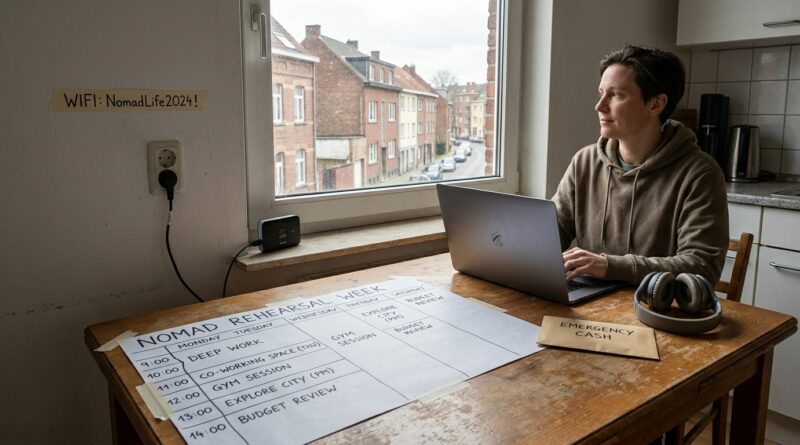
The New ‘Nomad Rehearsal Week’: How To Test Digital Nomad Life In 7 Days Without Wrecking Your Finances Or Job
You do not need to quit your job, book a one-way flight, or drain your savings to find out if digital nomad life actually suits you. That fear is real. A lot of people are not scared of visas or laptops or airport lines. They are scared of discovering, too late, that they hate working from rentals, cannot focus in new places, or burn cash faster than expected. That is what freezes people. Not the dream, but the risk of getting it wrong.
A seven-day nomad rehearsal week is a much safer test. You keep your income. You keep your deadlines. You keep the stakes low. But for one week, you simulate the real thing as closely as possible. You work away from home, deal with Wi-Fi, time zones, meals, noise, and routine disruption, then measure what actually happened. If you are asking how to test digital nomad life before quitting my job, this is the practical answer. It is not glamorous. That is the point. It is cheap, concrete, and honest.
⚡ In a Hurry? Key Takeaways
- A nomad rehearsal week lets you test remote travel life without quitting your job or making a big money mistake.
- For seven days, copy the real conditions: new workspace, travel-style budget, limited gear, and your normal workload.
- The goal is not to have fun. It is to find weak spots early, while they are still cheap and fixable.
What a “Nomad Rehearsal Week” actually is
Think of it as a stress test for your future life.
Not a vacation. Not a weekend getaway. Not “I answered two emails from a beach cafe.”
A proper rehearsal week means you keep your regular work obligations and change the environment around them. You simulate the stuff that often breaks first when people go nomad: bad internet, odd schedules, tiny workspaces, food costs, loneliness, and the mental drag of always being slightly out of place.
If you can function well for seven days under those conditions, that tells you a lot. If you cannot, that also tells you a lot, and it is much better to learn that while sleeping in a two-hour train radius from home than after signing a month-long booking abroad.
Why this works better than endless planning
People often try to think their way into confidence. They read city guides, compare visas, watch YouTube, and make spreadsheets.
Some of that helps. But a lot of fear only goes away when reality replaces fantasy.
The truth is, digital nomad life is less about “Can I technically work online?” and more about “Can I still do good work when my environment gets harder?”
That is the messy middle most people skip.
If this idea appeals to you because you want more freedom without blowing up your finances, you may also like The New ‘Three-Day Freedom Week’: How Remote Workers Can Trade One Workday For 10 Extra Years Of Life Without Killing Their FI Plan. It gets at the same basic truth: freedom works best when you test it in smaller, safer chunks first.
How to set up your 7-day test
1. Pick a location that is inconvenient enough to be real
Do not do the rehearsal from your couch.
You need enough friction to make the test useful. Ideally, stay somewhere outside your home for the full week. That could be a nearby city, a short-term rental, a house sit, or even staying with a friend if you can still create work boundaries.
Good rehearsal locations are:
- 1 to 4 hours from home
- Affordable to reach
- Safe and boring enough that you will not treat it like a holiday
- Equipped with workable internet, but not luxury everything
The goal is realism, not suffering. You want conditions that feel different from home but do not create a financial mess if the experiment goes badly.
2. Keep your real workload
This part matters most.
If you reduce your meetings, postpone client work, or give yourself a light week, you are not testing nomad life. You are testing a retreat.
Use a normal week. Same deadlines. Same calls. Same pressure. Same expectations from your boss, team, or clients.
If you are wondering how to test digital nomad life before quitting my job, this is the answer people avoid because it is less fun. You have to test the lifestyle under the exact condition that pays for it. Work.
3. Use the gear you would actually travel with
Do not bring your full home office if you would never carry it abroad.
Try working with:
- Your laptop
- Your usual charger setup
- A compact mouse or keyboard if that is realistic
- Noise-canceling headphones if you already own them
- A phone hotspot backup
This is where hidden annoyances show up fast. Maybe your battery life is terrible. Maybe your calls are awkward without a second screen. Maybe your bag hurts your shoulders. These are boring problems. They are also the exact problems that make people miserable on the road.
4. Copy a travel-style budget
For the week, track every expense like you are already living this way.
Include:
- Accommodation
- Transport
- Coffee and coworking
- Mobile data
- Laundry
- Food, including convenience meals
- Any emergency spending because something went wrong
This part can be eye-opening. People often underestimate food, short-notice transport, and the premium you pay for convenience when tired.
If your weekly test already feels expensive, imagine doing it for three months with decision fatigue on top.
The 7-day rehearsal plan
Day 1: Travel and setup day
Get to your test location like a normal traveler would. Carry your gear. Check in. Test the Wi-Fi. Find the nearest backup workspace. Buy groceries or figure out where you will eat.
Notice how much energy disappears before work even starts.
That matters. Travel days are not free.
Day 2: Deep work day
Try to do your most focus-heavy tasks.
Can you write, code, design, analyze, or handle detail work in the new environment? Do not just ask, “Can I get through the day?” Ask, “Can I do my best work here?”
Day 3: Meeting day
Take calls. Join video meetings. Test your camera angle, microphone, background noise, and internet stability.
This is where many remote workers find the gap between “technically possible” and “professionally comfortable.”
Day 4: Disruption day
Force a backup scenario.
Work from a cafe for half a day. Use your hotspot for one meeting. Change locations. Deal with a bad chair. Simulate what happens when the rental internet drops or the apartment turns noisy.
Because one day, it will.
Day 5: Admin and life logistics day
Do the boring stuff after work. Laundry. Grocery shopping. Booking your next place. Budget checking. Walking to get basic supplies.
Nomad life often looks exciting online because nobody posts the hour they spent searching for a quiet place to take a call and then paying too much for mediocre eggs.
Day 6: Energy check day
By now, the novelty is gone.
Ask yourself:
- Am I more tired than usual?
- Am I behind on work?
- Am I spending more than I expected?
- Do I feel trapped, lonely, distracted, or weirdly relieved?
This is one of the most useful days in the whole test.
Day 7: Review day
Go home, or finish the week by doing a full review before real life rushes back in.
Do not just ask whether you liked it. Ask whether it worked.
What to measure during the week
You need data, not vibes alone.
Track these five things
- Work quality: Did your output stay solid?
- Stress level: Were you calmly adapting or constantly scrambling?
- Cost: What did the week really cost per day?
- Energy: Did the logistics eat your brain?
- Enjoyment: Did the lifestyle feel good enough to repeat?
Rate each one from 1 to 10 every night. Keep notes. A simple phone note is enough.
Red flags that your current setup is not ready yet
This does not mean “give up.” It means “fix the weak spots first.”
- You missed deadlines or produced noticeably worse work.
- You needed a lot more money than your current budget allows.
- You felt anxious every time the internet hiccuped.
- You could not focus without your home setup.
- You hated the constant decisions around food, workspace, and planning.
- You realized your job depends on quiet, stable conditions more than you thought.
Those are useful findings. They can help you decide whether you need a better income cushion, stronger systems, better gear, or a slower version of location independence.
Green flags that you may be more ready than you think
- You stayed on top of work with only minor adjustments.
- You solved problems without spiraling.
- Your daily costs were manageable.
- You enjoyed the change in environment more than expected.
- You felt sharper, lighter, or more engaged in your routine.
If that happens, great. You do not have to jump straight into full-time nomad life. You can scale up carefully.
What to do after the rehearsal week
If the week went badly
Good. Seriously.
You just avoided making an expensive mistake.
Now ask what failed. Was it your budget? Your energy? Your internet backup plan? Your need for routine? Your job structure?
Most problems can be improved with a second, smarter test later.
If the week went well
Do not assume you are ready for a year abroad. Run a bigger test.
Try two weeks next time. Then maybe a month. Change one variable at a time. Another location. A different time zone. A more demanding client week.
This is how confidence gets built without drama.
At a Glance: Comparison
| Feature/Aspect | Details | Verdict |
|---|---|---|
| Cost risk | A 7-day local or regional test keeps travel and housing costs low while still exposing real-world problems. | Best first step before any major move |
| Job safety | You keep your current role, normal deadlines, and paycheck while testing your ability to work on the move. | Low-risk way to get honest answers |
| Lifestyle fit | Shows whether you can handle logistics, isolation, changing workspaces, and travel friction without romantic filters. | More useful than reading another city list |
Conclusion
The smartest way to test digital nomad life is not with a dramatic exit. It is with a controlled rehearsal. Right now the digital nomad conversation is dominated by visas, tax hacks, and Instagram cities, but what people in the forums are actually struggling with is the messy middle between theory and reality. They finally have remote income, yet still feel frozen by fear of running out of money or collapsing under real-world logistics. A structured rehearsal week gives you something you can do this month. It is cheap. It is concrete. And it is brutally honest about whether your income, routines, and mental bandwidth are truly ready for location independence. That is far more valuable than another dreamy list of “best nomad cities.” You do not need perfect certainty. You just need a safer way to find out what is true.